300″APPROXIMATE
GROSS-SCORE CLASS
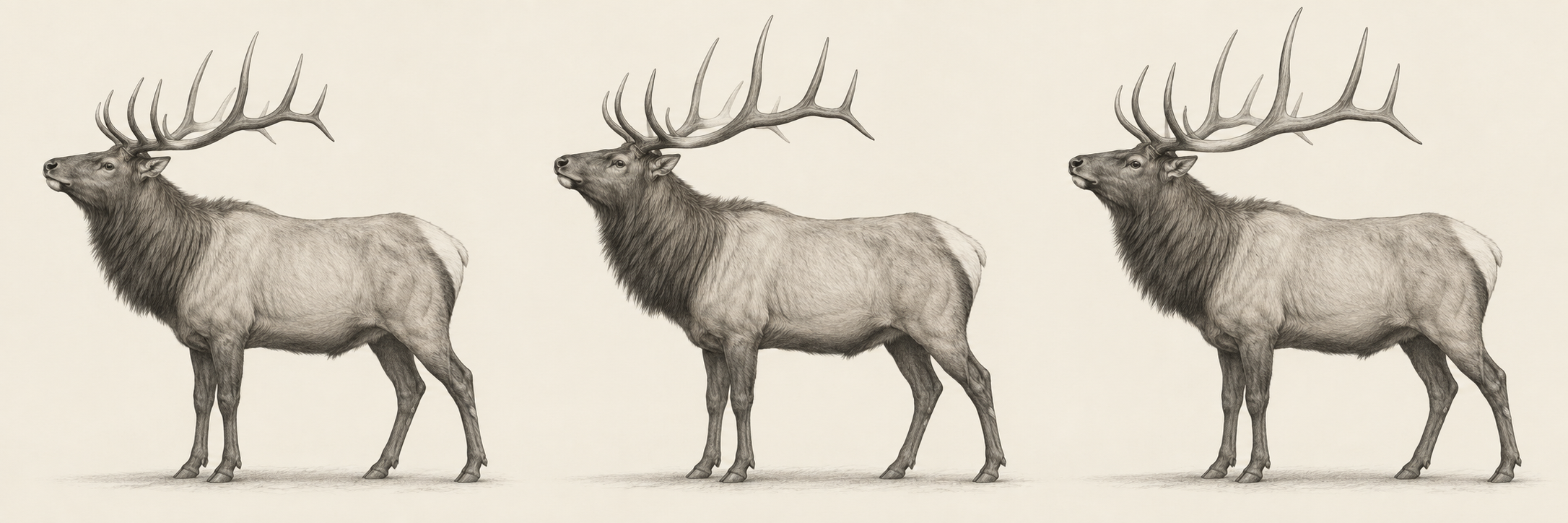
A sweeping frame.
An impressive mature rack with comparatively shorter tines and slimmer beams.
THE ANATOMY OF AN IMPRESSIVE NUMBER
What does a 350-inch bull actually mean?
Turn it. Trace it. See what adds up.
THE FIELD SKETCHBOOK / 01
Three approximate gross-score classes.
A similar pose and body scale. A different rack.
300″APPROXIMATE
GROSS-SCORE CLASS
An impressive mature rack with comparatively shorter tines and slimmer beams.
350″APPROXIMATE
GROSS-SCORE CLASS
More length through the beams and tines, with greater circumference adding to the total.
400″APPROXIMATE
GROSS-SCORE CLASS
Long tines and substantial beams combine into an unusually large rack.
Artist’s interpretation. AI-assisted pencil-style studies of typical racks, not scored animals. Different shapes can produce the same total. These drawings suggest relative proportions; the interactive models below explain the measurement arithmetic.
Open the full drawingPreparing your specimen…
Drag to rotate · Use + / − to zoom
B&C GROSS · TEACHING EXAMPLES
01 / 05 · THE BREAKDOWN
A “350-inch bull” describes a combined antler measurement. It is not the animal’s height, weight, or the length of one antler.
B&C-style gross teaching examples, not a scanned animal or an official score. Model surfaces and measurement paths are simplified. How this works
These symmetrical examples use the same values on each side. All dimensions below are in inches.
| Measurement | Left | Right | Contribution |
|---|---|---|---|
| Main beam | 52 | 52 | 104 |
| Tine 1 | 16 | 16 | 32 |
| Tine 2 | 17 | 17 | 34 |
| Tine 3 | 15 | 15 | 30 |
| Tine 4 | 20 | 20 | 40 |
| Tine 5 | 11 | 11 | 22 |
| Circumference 1 | 8 | 8 | 16 |
| Circumference 2 | 7 | 7 | 14 |
| Circumference 3 | 6 | 6 | 12 |
| Circumference 4 | 5 | 5 | 10 |
| Inside-spread credit | Added once | 36 | |
| Total | 157 per side + 36 spread | 350 | |
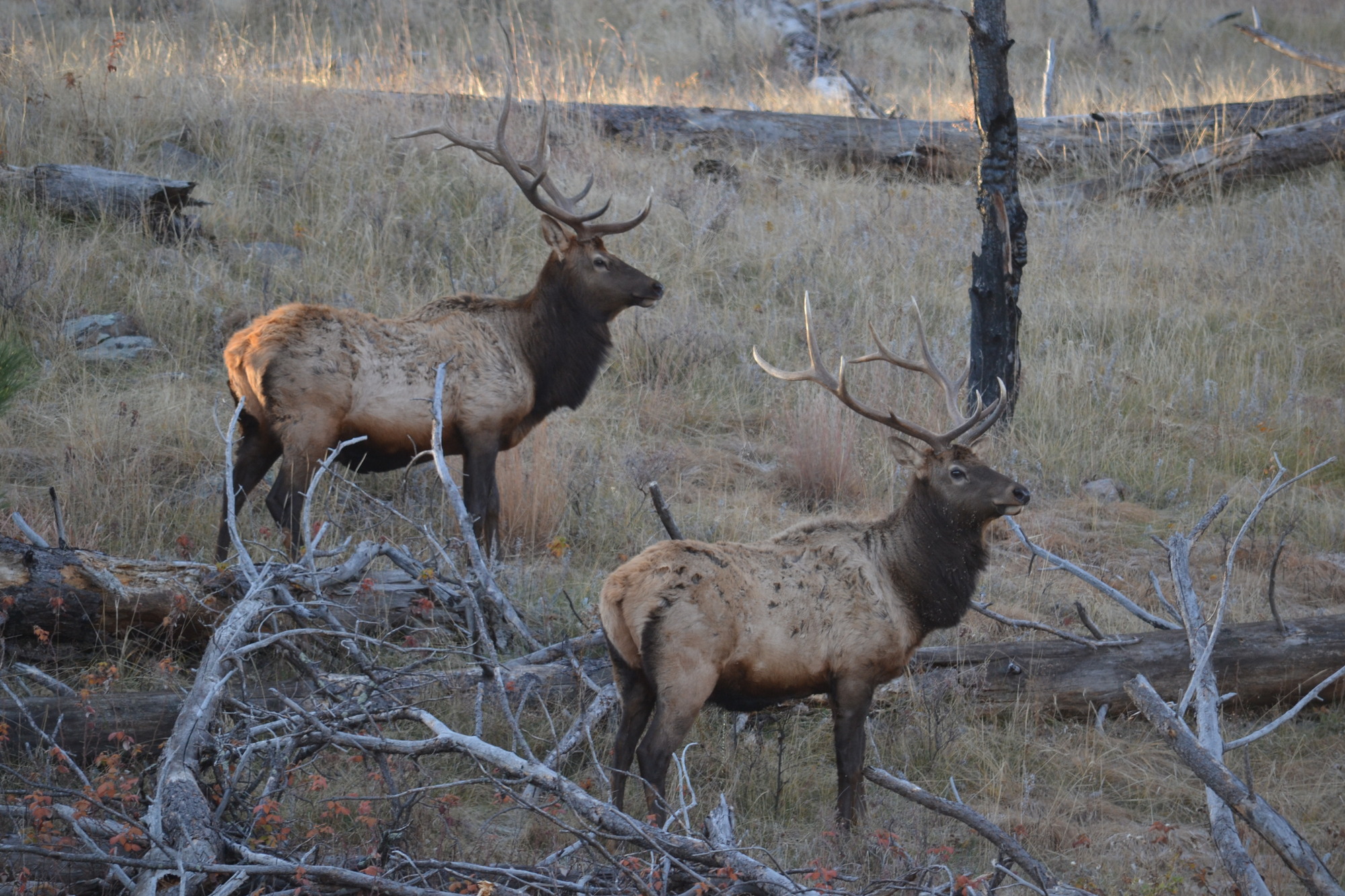
BACK OUT IN THE WILD
Take what you noticed in the model into a real encounter. Follow the sweep. Pick out the tines. Look at the thickness of the beams.
SAME ANTLERS. DIFFERENT RULEBOOKS.
A number needs context: the organization, the category, and whether it is gross or net. These are three names you will hear.
For typical American elk, the final net score deducts side-to-side differences and abnormal-point length. Gross is the total before deductions.
Gross versus netSCI’s typical elk method totals the included measurements without a symmetry deduction. Typical and non-typical categories have different rules for which tines count.
SCI measuring manualAn archery record organization that uses the Boone and Crockett / Pope and Young measurement system. Its record-entry requirements are separate from the measurements themselves.
P&Y measurement systemIn this interactive: our 300, 350, and 400-inch examples illustrate gross totals using typical American elk measurement concepts from B&C. They are symmetrical teaching models, not official records or a conversion between organizations.
BEYOND THE NUMBER
Scoring grew out of hunting and record keeping. Here, it is a way to look more closely at antler structure. A number cannot capture the experience of hearing a bugle or watching a bull move through the timber.
CURIOUS IS A GOOD LOOK.
Designed for discovery. Grounded in the measurement rules. Clear about what is an illustration.
No. Both use antler measurements, but their rules and categories differ. Boone and Crockett’s typical net score deducts asymmetry and abnormal points. SCI’s typical elk method has no symmetry deduction and counts its qualifying typical tines. Always identify the system and category before comparing numbers.
No. It is a total assembled from several antler measurements. It does not describe body height or weight. Always ask which scoring system and whether the number is gross or net.
Gross describes the total before deductions. In the typical Boone and Crockett system, the final net score deducts side-to-side differences and abnormal points. Our paired teaching models are symmetrical, with no abnormal points. They are unofficial examples, not certified scores.
In the usual western description, a 6 × 6 has six points on each antler, including each main-beam tip. That is twelve across the pair. Point count alone does not determine score.
A photograph can suggest proportions, but perspective hides depth and changes apparent size. Precise scoring requires physical measurements following the chosen system. Our viewer teaches the components; it does not score a photographed animal.
These are original, dimensioned 3D illustrations of a typical six-point pattern. Their proportions follow the example measurements, but surface paths and branching junctions are simplified. The totals come from the listed example measurements, not a certified measurement of the rendered mesh.
FOLLOW THE MEASUREMENTS
This independent educational feature explains selected concepts from the Boone and Crockett typical American elk system, with a brief comparison of other organizations. It is not affiliated with or certified by Boone and Crockett Club. For the complete procedure, definitions, and official measurement requirements, consult the original sources.
KEEP THAT CURIOSITY GOING