ONE ANIMAL. AN EXTRAORDINARY VOICE.

THE BUGLE

Listen to real Yellowstone recordings, then look inside an animated explanation of how a bugle is made.

02 / THE SOUND LAB

THAT’S AN ELK.
YEAH. REALLY.

Headphones on.
Let the mountains do the talking.

YELLOWSTONE FIELD RECORDINGS
01FIELD
TAKE

THE OPENING CALL

A bull’s voice breaks through the quiet at Mammoth Hot Springs.

PRESS PLAY. MEET THE VOICE.
0:000:34

PICK YOUR CALL

WHAT ARE YOU HEARING?

A bugle can combine a low voice with a high whistle. One animal. Two sound sources. An entire valley paying attention.

Inside the science
Original NPS recordings · Public domain

THE ANATOMY OF A BUGLE

INSIDE THAT
UNREAL VOICE.

Follow the air. Meet the muscles.
Explore how one animal can produce two pitches.

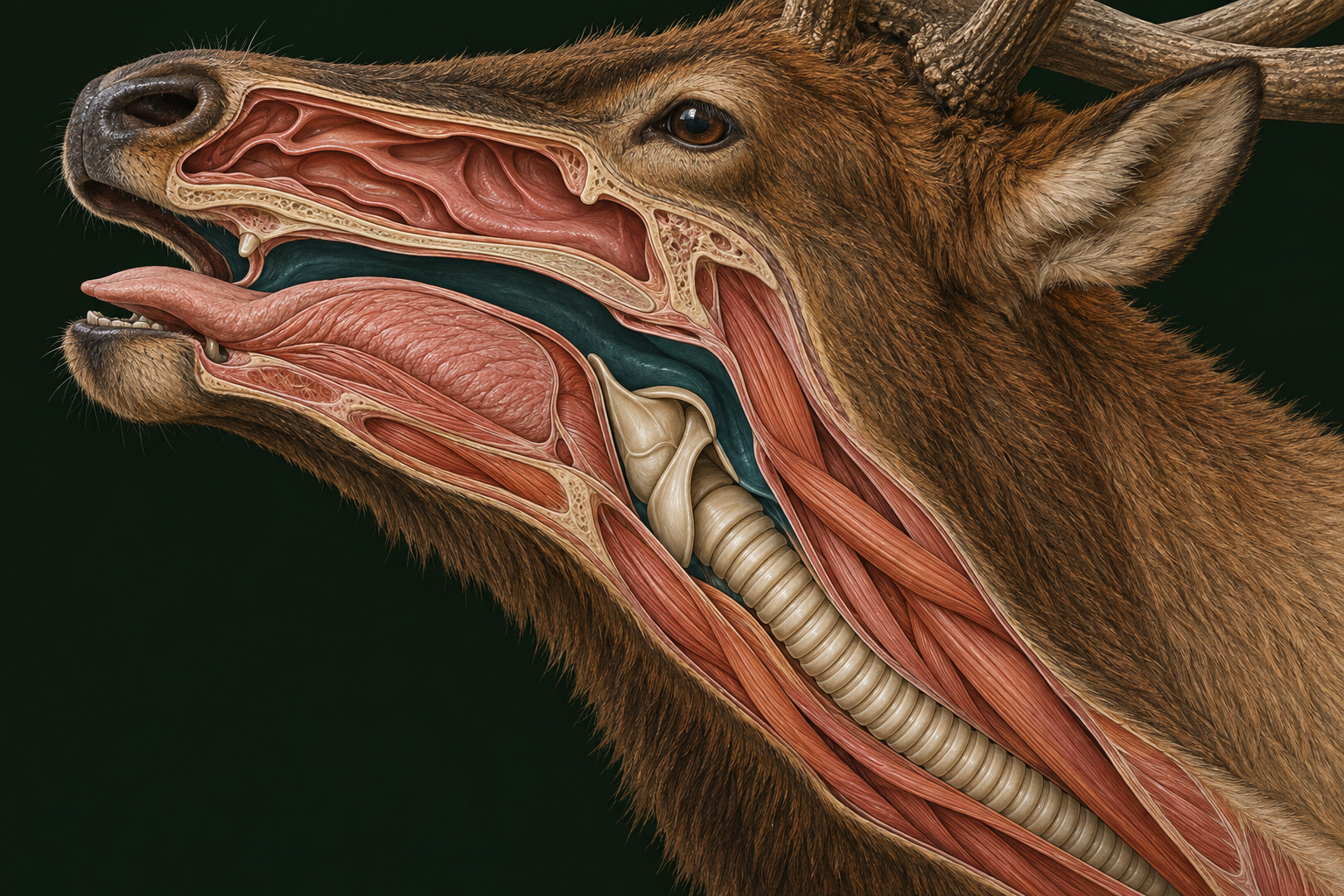
ELK VOCAL APPARATUS / ILLUSTRATED CUTAWAYEXPLANATORY MODEL
Illustrated side cutaway of an elk’s head and neck, showing the tongue, airway, larynx, trachea, and surrounding tissue
01
AirflowTrachea

Illustrative proportions · airflow path simplified

01 / PHYSIOLOGY

Air supplies the energy.

Exhaled air travels up the trachea toward the larynx. Pressure below the vocal folds supplies energy for phonation.

WATCH THE MODEL

Follow the blue airflow toward the voice box.

Trachea

The windpipe carries air between the lungs and larynx.

Research behind this step

MAGNIFIED / CONCEPTUAL VIEW

The vocal folds.

Vocal-fold tissueAir through the glottis

Muscles adjust position and tension. Airflow drives the rapid vibration. This geometric diagram shows the principle, not an endoscopic view.

Animation slowed for visibility. Real cycles are far faster; 145 Hz means about 145 cycles per second.

TWO SOURCES / ONE CALL

A voice. And a whistle?

LOW COMPONENTStudy mean ≈145 Hz
HIGH COMPONENTStudy mean ≈1,426 Hz

These are study averages, not fixed pitches for every elk. Traces show an illustrative contrast, not a measured waveform.

Real NPS audio plays independently. The diagram is not synchronized to this animal’s internal movements.Original NPS recordings
How closely does this match a real bugling elk?

This is a research-informed illustration, not a scan or a recording inside a living elk. The five steps separate interacting processes for explanation; they are not a measured sequence of muscle events. Airflow arrows, tissue motion, timing, and proportions are simplified.

Earlier biomechanical and anatomical work explored high-tension vocal-fold mechanisms. Reby and colleagues’ 2016 analysis supported two sound sources and proposed an aerodynamic whistle for the high component. The exact whistle mechanism is not settled, so the model marks it as a hypothesis.

Titze & Riede · 2010 model ↗Comparative elk anatomy ↗Reby et al. · 2016 acoustics ↗

KEEP THAT CURIOSITY GOING

THERE’S MORE OUT HERE.

Life as an ElkThrough Their SensesInside the RutExplore everything